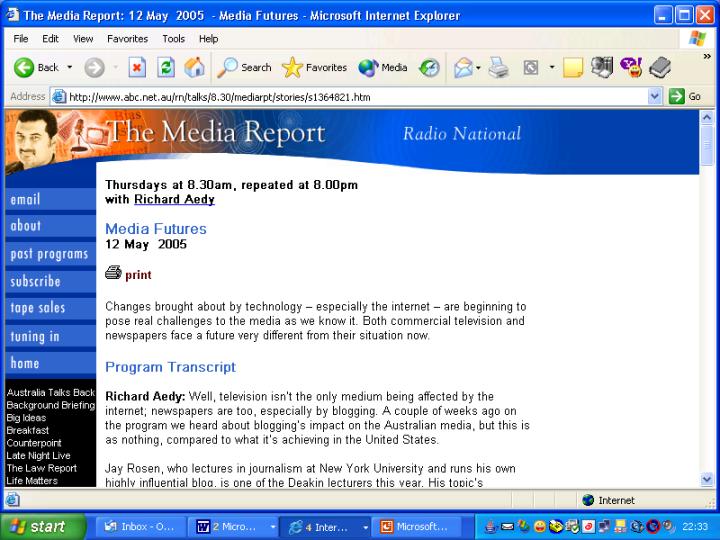
By now, many young Australians would be glued to their mobile phones catching up on the latest gossip in Random Place, a made-for-mobile soap opera launched last year. At least that is what I assume after reading the article by Lara Sinclair, in The Australian, dated 3 March 2005.
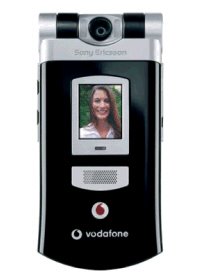
At the time of the article, the mobile soap opera was about to be launched, as carriers, the media, phone companies and production houses vie for slice of the mobile data market, estimated at AU$1 billion. As the 3G rollout gains ground, it fuels a push to create suitable video content.
Each mobisode of Random Place was to comprise still images of the characters complete with captions that unveil the storyline. Subscribers would have to pay between AU$1.50 and $2.50 a week for six months to view the show, however as I understand it, the show has since found sponsors and is distributed free upon subscription, from what I infer from its website.
Thank goodness for that! Can you imagine forking out $60 in six months to view blurred images and squint at tiny text? If the content had been video images, then maybe that would have been more appealing to me, but still images and text? Give me my telly anyday!
And how many people actually have video-enabled phones already? Sorry, but I’m one of those people who just use the mobile phone to send/receive calls and SMSes. I’m also super-paranoid about the effects of radiation and I try to limit my usage.
While I have no doubts the demand for mobile content will grow exponentially in the next few years as consumers become inseparable from their phones. The people laughing all the way to the bank will be production houses, advertisers and the carriers.
For this to really take off, prices for data transfer will have to drop significantly and content will have to be much richer. The exception is Japan and Korea, where there is a ready market. Cost of content there ranges between 3 to 5 cents, while in Australia it’s 50 – 70 cents.
Ultimately the choice lies with consumers, so let’s see how it goes…

 This has been fun.